






The numbers, first
A verified work email costs 1 credit on Clu, our product: about 6.5 cents a record on the Starter plan, which is $49 a seat a month for 750 credits. A verified email plus a phone number on the same record is 11 credits (about 72 cents), a phone number alone is 10, and search is 0. Clu gets those records from a 25+ provider waterfall, inside AI agents that also find the buyers and send the sequences. On our own 500-lead benchmark, Clu returned 98% verified email and 85% phone numbers, where single-source providers returned 70 to 80% email and 30 to 60% phone on identical input. Company enrichment is 1 credit per company. A new workspace runs the full Pro plan free for 14 days: 250 credits, 3 seats, every Pro feature. Free is $0 for 50 credits a month after that. Last updated: October 29, 2026.
Contact data enrichment costs 1 credit per verified email in Clu, roughly 6.5 cents at Starter pricing, 10 credits for a phone number and 11 for both on the same record. In the Clu 500-Lead Enrichment Benchmark 2026 that path returned 98% verified email and 85% direct dial on 500 stratified B2B leads, against 70 to 80% email and 30 to 60% phone from single-source providers given identical input. Search is 0 credits, exports are never metered, and a record that resolves to nothing is not billed. This page is written for someone with a budget and a list, so every section carries the price and the measured rate rather than a definition.
Most enrichment pricing pages quote a plan and leave you to work out the cost of the job. The arithmetic that matters is plan price divided by credits, then credits per record. On Clu that is $49 per seat for 750 credits at Starter (6.53 cents a credit) and $89 per seat for 1,500 at Pro (5.93 cents), with 25% off on annual billing. Everything below is priced in those units.
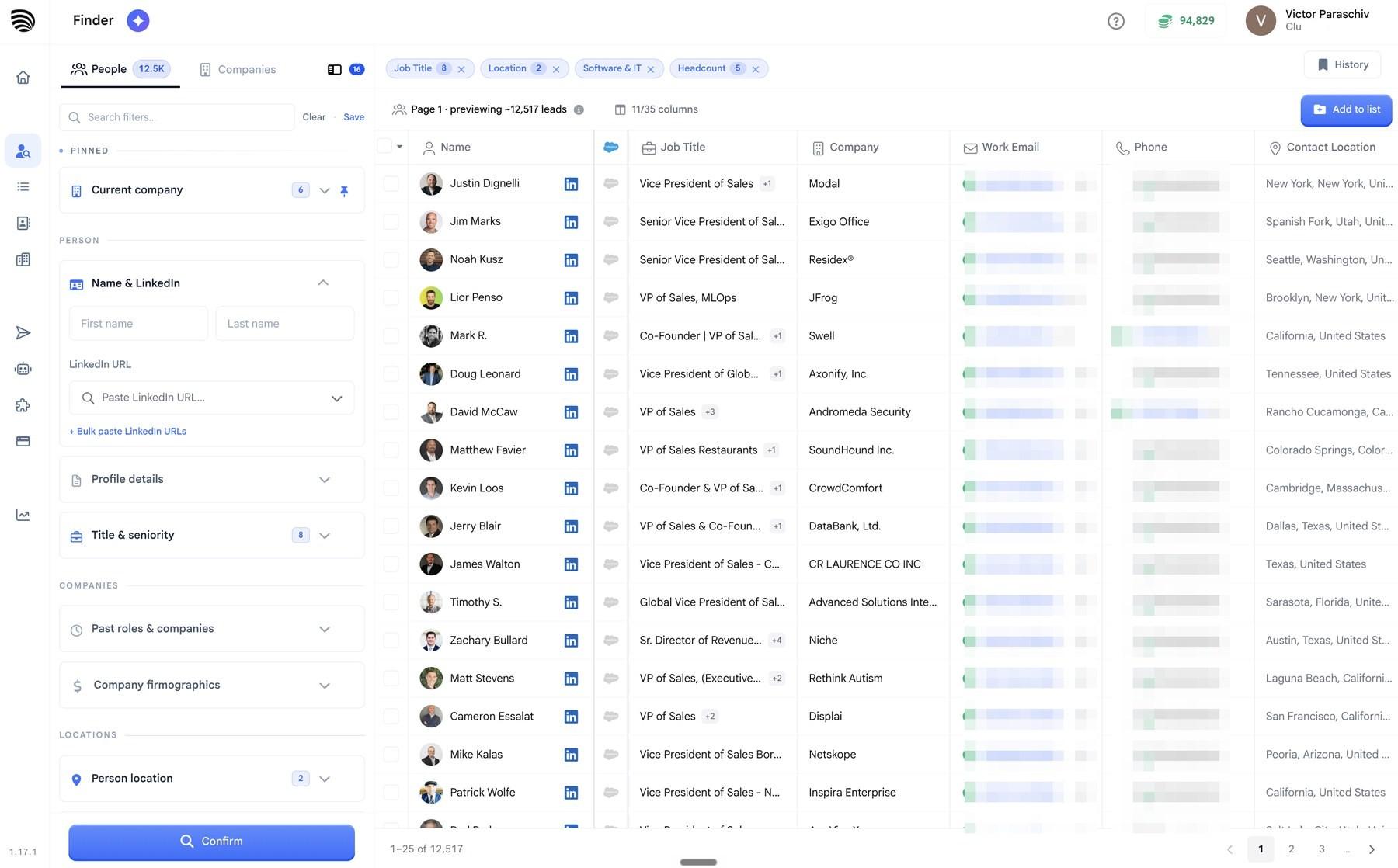 Filtering and enriching a contact list by title, headcount and location
What does contact data enrichment cost per record?
One verified email is 1 credit, which is 6.53 cents on Clu Starter ($49 per seat for 750 credits) and 5.93 cents on Pro ($89 per seat for 1,500). That credit returns the verified email along with LinkedIn URL, job title and company, so it is a record rather than a string. A phone number is 10 credits, 65 cents at Starter. Email and phone together on one record is 11 credits, 72 cents. A company record is 1 credit. Search across either People Search or Company Search is 0 credits, so you can size and filter a list before spending anything. Email, phone and company enrichment is charged only when data comes back, so an unresolvable record costs zero rather than a wasted credit.
What match rate should I expect from contact data enrichment?
Expect 98% verified email and 85% direct dial if the input is clean B2B, which is what Clu measured in the Clu 500-Lead Enrichment Benchmark 2026 on 500 stratified B2B leads. Single-source providers returned 70 to 80% email and 30 to 60% phone on the same 500 records. The gap comes from architecture rather than from vendor quality. One provider covers one slice of the market, and a waterfall queries the next one when the first returns nothing. Two caveats worth pricing in. First, match rate falls when the input is thin, because a row with only a first name and a company is a harder resolution than a row with a LinkedIn URL. Second, phone coverage is always lower than email coverage at every vendor in this category, so budget 10 credits per phone number rather than assuming email pricing scales to phone.
Clu holds no index to age against. Every request resolves the record live through a waterfall of 25+ providers and verifies the email before returning it, which is how it produced 98% verified email and 85% direct dial on 500 stratified B2B leads. That means the cost of staying current is a re-run at 1 credit per record rather than a subscription to somebody else's refresh schedule.
Source: Cognism, Data Decay & Degradation (2025)How does waterfall enrichment differ from a single source?
A single-source provider answers from one dataset and returns nothing when that dataset has no row for your contact. A waterfall queries providers in sequence, stops at the first verified hit, and charges once for the record rather than once per attempt. Clu's waterfall draws on 25+ providers, including Wiza, Hunter, Prospeo, Findymail, LeadMagic, Icypeas, AnyMailFinder and Crustdata on discovery and resolution, with ZeroBounce and Emailable on verification. You do not build or maintain that cascade. Its order is tuned centrally against real provider performance, so two runs a month apart behave the same way. The measured result of that design on 500 stratified B2B leads was 98% verified email and 85% direct dial, against 70 to 80% email from single-source providers on the same input. See waterfall enrichment vs single source for the run-level comparison.
What do you get back per enriched contact record?
A 1-credit contact enrichment returns the verified work email, the LinkedIn profile URL, the current job title and the company, with a confidence signal on the email. Add 10 credits and the same record carries a phone number. Add a company enrichment at 1 credit and you get the firmographic layer: domain, industry, headcount band and headquarters location. Clu also ships ICP scoring from 0 to 100 on the enriched record, and AI research on each lead, with sources, at 3 credits for the company or the contact and 5 for both. What you do not get, at any price, is intent data or technographic and tech-stack filters. Clu does not carry those, and no plan unlocks them.
What does company data enrichment cost and return?
Company data enrichment is 1 credit per company in Clu, the same price as a verified contact email, which is about 6.5 cents on Starter and 6 on Pro. It returns the resolved domain, industry, headcount band, headquarters location and the firmographic fields that let you segment an account list. Company Search runs at 0 credits, so you can build and filter the account set before enriching any of it. The honest limit is installed technology: Company Search exposes structured firmographic filters, and nothing in Clu searches or filters by tech stack. If your account scoring depends on installed technology, that input has to come from somewhere else. For a provider-level comparison see best firmographic data providers.
How do enriched contacts land in a CRM?
Clu writes the enriched fields back onto the existing CRM record, with sync for HubSpot and Salesforce, and its agents push contacts to Salesloft and Lemlist for sequencing. The direction runs both ways: pull a CRM segment in as the input list, enrich it, and write verified email, direct dial and firmographics back onto the same object rather than creating a duplicate. CRM sync and the REST API start on the Pro plan at $89 per seat a month. If the job is specifically cleaning and filling an existing HubSpot or Salesforce database rather than enriching a fresh list, the CRM data enrichment guide is the operator's version of this page.
How do I run a test before buying contact data enrichment?
Take 100 records from your own ICP, never a vendor sample, and hold back the emails you already have so you can score the answers. Run the same 100 through each finalist on the same day and measure four things: match rate, verified rate against a real SMTP check, phone fill rate, and bounce rate on a live send to 50 of them. On Clu that test costs nothing. Every new workspace starts on the full Pro plan for 14 days with 250 credits and 3 seats, and CSV upload is available from the first minute, so 100 email-only enrichments consume 100 of the 250 credits. The Clu benchmark is this exact protocol at five times the sample size: 500 stratified B2B leads, 98% verified email, 85% phone numbers.
What does it cost to enrich 10,000 contacts?
Email only, 10,000 contacts is 10,000 credits. At Pro's 10,000-credit level, $449 a month for one seat, that is one month, about 4.5 cents a record, and unused credits roll over. Email and phone on all 10,000 is 110,000 credits, which is past Pro's largest monthly credit level and is an Enterprise conversation rather than a plan choice, so most teams enrich email across the whole file and buy dials only for the segment that gets called. Search stays at 0 throughout, and any record that resolves to nothing is not billed, so the real invoice is usually below the arithmetic.
Do I pay when a contact cannot be enriched?
No. Clu charges on result, not on attempt, so a row that returns no verified email costs 0 credits no matter how many of the 25+ providers were queried behind it. This matters more than it sounds at a 98% match rate, because the 2% that fail are the rows a per-attempt vendor would still bill. Two things to know about how this interacts with the rest of the pricing. Search never costs anything, on either People Search or Company Search, and exports are not metered, so moving a record out to CSV, to a CRM or through the API does not re-charge for data you already paid for. Apollo, by contrast, states on its own pricing page that export credits are consumed whenever a contact leaves the platform, "such as CSV files, CRM syncs, or API enrichment" (apollo.io/pricing, read September 1, 2026).
Is pay-for-results billing unique to Clu?
No, and any page that says so is wrong. Apollo and Clay both document result-based or credit-refund behaviour of some kind, so "you only pay when we find data" is a category norm rather than a differentiator. Two things about the Clu model are genuinely uncommon and worth checking your shortlist against. First, search costs 0 credits with no export meter on top, so discovery and delivery are not billed twice for the same record. Second, every paid MCP operation returns a signed cost quote that has to be accepted before it runs, which means an AI assistant driving the account cannot spend credits without that quote. Price the two separately when you compare: the per-credit rate, and whether the same record gets charged again on its way out. Vendors that keep the number behind a quote work differently again, and Seamless.AI pricing works through one of them.
How much does contact enrichment cost at other vendors?
Compare on cost per delivered record rather than plan price, because credit definitions differ. Clu Starter is $49 per seat a month for 750 credits per seat, Pro $89 per seat for 1,500 per seat with API and agents, Enterprise on custom pricing, 25% off annually. Clay publishes Launch from $167/month with 15,000 actions and 3,000 data credits a month, and Growth from $446/month with 40,000 actions and 6,000 data credits, with Free at $0 for 500 actions and 100 data credits (clay.com/pricing, read September 1, 2026), and Google's own AI Overview quotes the same Launch figure. The full field, priced from each vendor's own page and dated, sits in the B2B contact data pricing index.
Which contact data enrichment tool should I choose?
Clu (our product): Best for teams that enrich unevenly and want one shared credit balance across seats. Clu runs waterfall enrichment across 25+ providers inside AI agents that also find the buyers and send the sequences, and charges 1 credit per verified email and 10 per phone number, with search costing nothing and exports never metered. Starter is $49 a seat a month, and always-on agents and CRM sync start on Pro at $89.
Underneath that sentence, the choice usually comes down to three shapes. If you want a searchable index you can browse offline and quote a record count from, an owned-database vendor fits that habit better. If you want to compose your own multi-source pipeline and maintain it, a table-based tool fits. If you want a fixed, centrally tuned cascade with a measured number attached to it, that is the Clu case: 98% verified email and 85% direct dial on 500 stratified B2B leads, at 1 credit per verified email.
How often should contact data be re-enriched?
Quarterly for the whole database, and immediately before any campaign for the segment you are about to touch. The driver is decay rather than error: Cognism reports that 22.5% of B2B data goes bad each year, which on a 10,000-contact database means more than 2,000 records are inaccurate within twelve months. Clu has no refresh schedule of its own because it resolves each record at request time, so re-enrichment is a re-run priced at 1 credit per verified email rather than a subscription to somebody else's update cycle. A quarterly email-only pass over 5,000 records is 5,000 credits, which is one month of Pro's 5,000-credit level ($229). Prioritise the segment that gets mailed or called, not the archive.
What is the difference between contact enrichment and data cleansing?
Enrichment adds fields that were never there. Cleansing corrects or removes fields that are already there and wrong. A record with a name and a company and no email is an enrichment job, priced at 1 credit in Clu for the verified email plus LinkedIn, title and company. A record with an email that now bounces is a cleansing job, priced at half a credit per address for verification. Most real CRM projects are both, run in that order: verify first so you know what is broken, then enrich only the rows that came back empty, so you are not paying to re-find data you already hold. The data enrichment vs data cleansing page draws the line in more detail, and email list cleaning services covers the cleansing half end to end.
Can I enrich contacts through an API or an AI agent?
Yes. Clu ships a REST API v2 with about 30 endpoints covering people and company search, enrichment, lead lists and CRM sync, on Pro at $89 per seat a month. There is also an MCP server in beta with 30+ tools, included from Starter at $49 per seat a month, so an assistant like Claude can build and enrich a list without a browser. Credit prices are identical on every surface: 1 per verified email, 10 per phone, 11 for both, 0 for search. Two limits to design around before you build. The REST API takes structured filters rather than natural language, since natural-language search lives in Clu inside the app and in the MCP server, and API v2 ships no webhooks. Every paid MCP operation returns a signed cost quote first, so an agent cannot spend credits without that quote being accepted. An MCP server is not unusual in this category now: Apollo and Clay both ship one.
What can contact data enrichment not do?
It cannot tell you who is in market. Clu carries no intent data, no technographic or tech-stack filters and no real-time job-change alerts, and no plan adds them. It has no dialer. Paid plans include Sequences for email and call tasks, and the enriched record can also leave through CRM sync, CSV, the API, Salesloft or Lemlist. There is no owned contact database behind it either, which is the trade that makes the 98% figure possible and also means there is no record count to quote. Clu publishes no uptime SLA and holds no SOC 2 report today. If a buying committee needs any of those, price a second vendor into the plan rather than expecting a tier upgrade to cover it.
Is contact data enrichment legal under GDPR and CCPA?
For B2B outreach in the EU and UK, the usual lawful basis is legitimate interest rather than consent, which requires a documented balancing test, clear identity and purpose at first contact, and a working opt-out, with several member states layering stricter electronic-marketing rules on top. Under CCPA and CPRA, business contacts are in scope, so individuals can ask you to delete their data. The structural point for enrichment specifically: Clu sells no downloadable lists of strangers. You enrich records you already hold or search live, and each record resolves at request time, which makes suppression and deletion a per-record operation rather than a recall of a file already shipped. Confirm your own basis with counsel rather than with a vendor page, including this one.
How do I start enriching contacts without paying anything?
Create a workspace and you land on the full Pro plan for 14 days: 250 credits, 3 seats, and every Pro feature. CSV upload works inside that window, so the first real test is a file rather than a demo. 250 credits is 250 verified emails, or 22 records with email and phone together, or any mix, and search costs nothing throughout. After the 14 days the workspace drops to the $0 Free plan at 50 credits a month for as long as you want it, and paid plans start at Starter, $49 per seat a month for 750 credits. Run the file you actually care about while the trial is live. The step-by-step import and run is in how to enrich contacts.
What should a contact enrichment vendor be asked before signing?
Six questions, in this order. What is the match rate on my ICP, measured on my records rather than a sample. Is the email verified with an SMTP handshake, or only pattern-guessed. What is charged when nothing is found. Is export metered separately from enrichment. What happens to a record I ask you to delete. And what is the per-credit price after the discount lapses. Clu's answers are on this page: 98% verified email and 85% direct dial on 500 stratified B2B leads, syntax plus DNS and MX plus SMTP with catch-all detection on every email, nothing charged on an empty result, no export meter, per-record deletion because there is no shipped file to recall, and $49 per seat for 750 credits with no introductory rate to lapse.
“Buyers keep comparing enrichment vendors on database size, which is the one number that does not survive contact with their own list. The number that decides the invoice is cost per delivered record on your ICP, and the only way to get it is to run the same hundred rows through every finalist on the same afternoon.”
Last updated: October 29, 2026. Clu figures come from the Clu 500-Lead Enrichment Benchmark 2026: 500 stratified B2B leads, 98% verified email, 85% direct dial across a 25+ provider waterfall, with single-source providers returning 70 to 80% email and 30 to 60% phone on identical input. Clay and Apollo figures were read first-hand from each vendor's own pricing page on September 1, 2026.
References & Sources
- [1]
- [2]
- [3]
Related reading
- CRM data enrichment, an operator's guide to HubSpot and Salesforce
- How to enrich contacts, the step-by-step bulk guide
- The 500-lead enrichment accuracy benchmark
- B2B contact data pricing index
- What waterfall enrichment is, and how the cascade is ordered
- Email list cleaning services, the cleansing half of this job

 Omni

 Decagon

 Distyl


 Decagon

 WellSaid

 Omni
