






The B2B contact databases worth comparing in 2026: Clu (our product) for a verified work email and phone number on every row, found live across 25+ providers, from $49 per seat a month. Apollo.io for free access to 240M+ contacts, then $49 per seat a month billed annually. ZoomInfo for enterprise coverage with intent data and org charts, at no published price. Cognism for EU and UK mobiles. RocketReach for solo email lookups at $329 a year. UpLead for a written bounce guarantee at $99 a month. LeadIQ for LinkedIn-to-Salesforce capture at $20 a month. Kaspr for European LinkedIn prospecting at $49 per user a month billed annually.
| Tool | Index size (vendor-published) | How a record is verified | Free option | Entry price (date read) | Best for |
|---|---|---|---|---|---|
| Clu (our product) | No owned index; searches 1B+ profiles, 25+ providers per record | At request time: syntax, DNS and MX, SMTP with catch-all detection | 14-day Pro trial, then 50 credits/mo | $49/seat/mo (clugtm.com/pricing) | A verified email and phone on the same row |
| Apollo.io | 240M+ verified contacts, 30M companies | Apollo's own seven-step validation | Free plan, exports metered | $49/seat/mo annual, $65 monthly (Sep 7) | Free database access |
| ZoomInfo | 500M+ contacts, 100M+ companies | Contributor network plus crawl | None | No published price | Enterprise intelligence |
| Cognism | 90% of EU decision-makers (claimed) | Human phone checks on Diamond mobiles | None | No published price (Sep 1) | EU and UK data |
| RocketReach | 700M+ profiles | Crawl of the public web | 5 lookups | $27.42/mo billed annually (Sep 1) | Email lookup |
| UpLead | 160M+ contacts | Real-time email check at export | 5 credits, 7-day trial | $74/mo annual, $99 monthly (Sep 1) | A bounce guarantee in writing |
| LeadIQ | Capture layer over LinkedIn | Enriched during capture | 50 credits, 1 user | $15/mo annual, $20 monthly, 5 users (Sep 7) | Salesforce users |
| Kaspr | LinkedIn-linked, EU focus | Shown on the LinkedIn profile | 15 email + 5 phone credits/mo | $49/user/mo annual, $65 monthly (Sep 1) | LinkedIn prospecting |
Prices were read on each vendor's own pricing page on September 1, 2026, with Apollo and LeadIQ re-read in a rendering browser on September 7, 2026 because both draw their plan tables client-side. Clu publishes this page and is one of the eight; each entry is labeled by the job it does best and carries no score. Read the index column before the price column: those are vendor-published counts of profiles, and a count of profiles is not a count of deliverable records.
What a B2B contact database is
A B2B contact database is a searchable store of business contacts (work emails, direct dials, job titles and company firmographics) that sales teams use to build prospect lists and fill in records they already hold. Two architectures compete inside it. Apollo, ZoomInfo, RocketReach and Cognism sell access to an index they own and refresh on a schedule, and the size of that index is the number they market. Waterfall tools hold no index and resolve each record across many providers at the moment of the request, so their coverage is the union of those providers rather than a printed count.
The phrase also covers two products buyers often confuse. A B2B contact database sells access to people you have never met. Contact management software and a CRM organize the people you already know, which is where HubSpot, Zoho and Bitrix24 sit. Between the two sits what vendors call a contact data platform: a layer that pulls contacts from the CRM, marketing tools and data providers, removes duplicates, fills missing fields and re-verifies records on a schedule, so the CRM stays current without manual refresh projects.
The unit that settles the invoice is the same in every case: what you paid divided by the records that produced a delivered email. A cheap seat that returns a bounce costs more than a credit that returns an inbox.
The 8 B2B contact databases
1. Clu (our product): best for a verified email and phone on a list you already hold
Disclosure. We make Clu. Its 98% verified email and 85% direct dial figures come from our own 500-lead benchmark, which named no other vendor.
Our product
Clu
Clu publishes this page. Accuracy figures are from our own benchmark, not a third-party test.
Clu: best for teams that need a verified work email and a direct dial on a list they already hold, without signing several data vendors themselves. Clu runs waterfall enrichment across 25+ data providers in sequence and stops at the first deliverable result, at 1 credit per verified work email and 10 per phone number. A missed email or phone number costs nothing. It returns 98% verified work emails and 85% phone numbers on the Clu 500-Lead Enrichment Benchmark, which is our own test run on a 500-lead sample. Plans start at $49 per seat a month.
Clu, our GTM agent, turns one sentence into an agent that searches 1B+ profiles, enriches and verifies every person it finds, adds them to a sequence and posts each run to Slack, every week or on a CRM trigger.
- Product
- Plans
Free plan 50 credits a month. Starter $49 and Pro $89 per seat a month, and every seat adds its credits to one shared balance. Enterprise is custom. 25% off on annual billing.
- Credits
- Verified work email1
- Phone number10
- Both on one row11
- Validation0.5
- AI qualification5
- Trial
14 days of Pro, free: 250 credits, 3 seats, agents, Sequences and Clu in Slack.
- Fits when
- You need a work email and a phone number on the same row, verified, not two exports you reconcile by hand
- You want the finished list written straight into HubSpot, Salesforce or pushed to Salesloft, Lemlist rather than downloaded as a CSV you re-upload
- Pairs with
- Your existing sequencer, if you already run one. Clu pushes to Salesloft and Lemlist, and its own Sequences run email and call steps
- Your intent or signal vendor, if buying-stage scoring is part of your motion
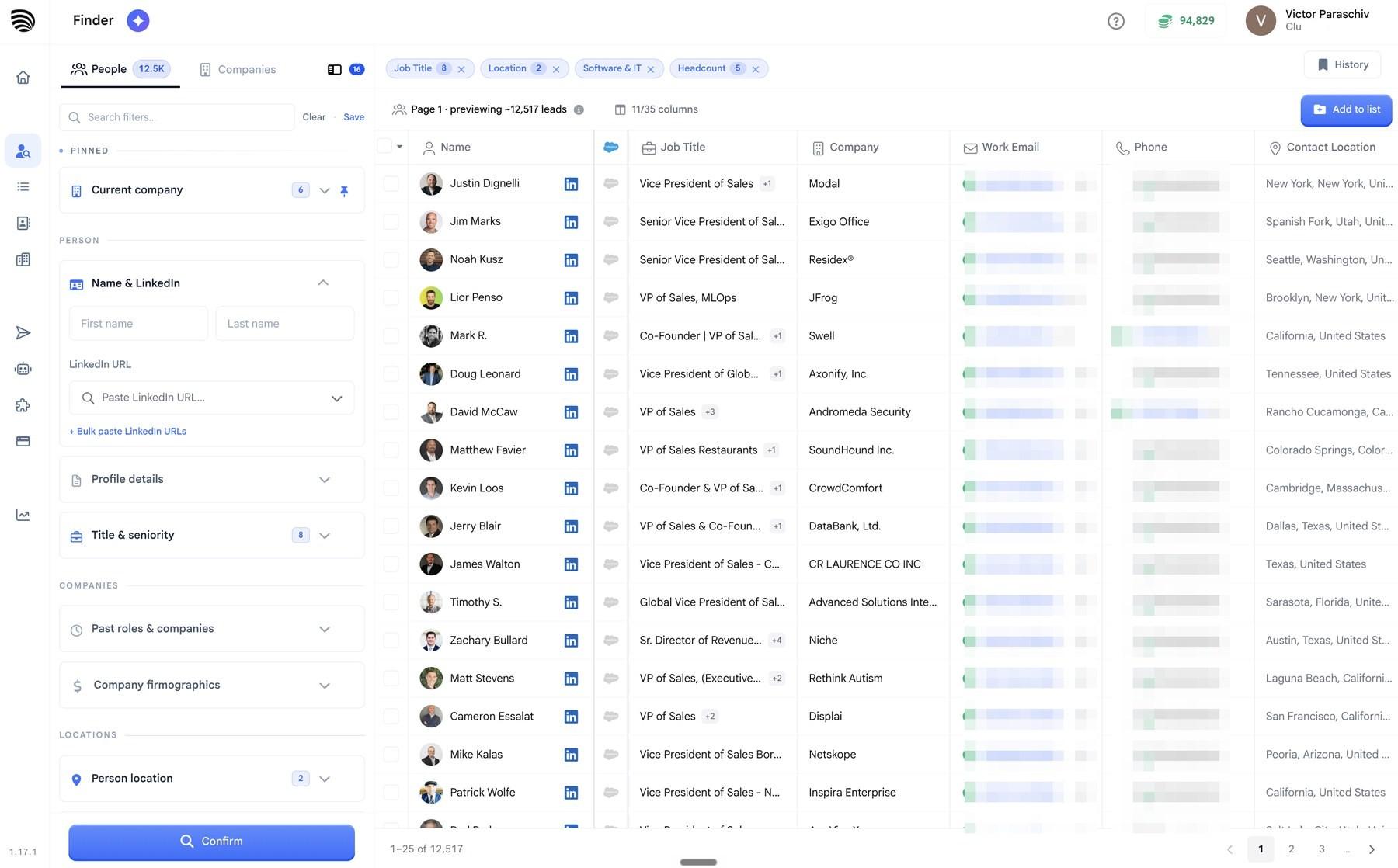 Clu People Search filtered by job title, company headcount and location
Clu holds no index of its own. Every request runs a waterfall across 25+ providers, and every email passes a syntax check, a DNS and MX lookup and an SMTP handshake with catch-all detection before it is returned, which is why its index column reads "no owned index" where Apollo reads 240M+. People Search costs 0 credits, so you can size a segment by title, seniority, industry, headcount and location before you spend anything. Paid plans include Sequences for email with call tasks, and Pro writes enriched records to HubSpot and Salesforce and pushes lists to Salesloft and Lemlist. There is no intent data, no technographic data and no built-in dialer, so account prioritization by buying signal comes from another tool.
2. Apollo.io: best free database access
Apollo publishes 240M+ verified contacts and 30M companies (apollo.io/product/search, read September 1, 2026) and a free plan it calls free forever, with sequences, a dialer and intent signals in the same seat. Basic is $65 and Professional $99 per seat a month on monthly billing, or $49 and $79 billed annually, and Organization is $149 ($119 billed annually) with a three-seat minimum (apollo.io/pricing, read September 7, 2026). Annual plans grant credits upfront, 30,000 per seat a year on Basic. Apollo's own pricing FAQ states that export credits are consumed whenever a contact leaves Apollo, "such as CSV files, CRM syncs, or API enrichment", so the same record can cost an export credit more than once.
In our own 100-lead test, Apollo.io returned a verified email for about 80% of leads and a phone number for about 45%. Per-seat pricing compounds as teams grow: 10 users on Professional is $990 a month billed monthly, or $790 at the annual rate. Our Apollo pricing guide walks every tier, and Apollo alternatives covers the wider field.
3. ZoomInfo: best for enterprise intelligence
ZoomInfo publishes 500M+ contacts and 100M+ companies, plus 135M+ verified phone numbers and 120M+ direct dials (pipeline.zoominfo.com, read September 1, 2026). On top of contact data it sells org charts, intent signals from Bombora and its own website visitor data, technographics and Chorus conversation intelligence. It publishes no price at any tier: zoominfo.com/pricing returned HTTP 403 on September 1, 2026. Vendr reports a median contract of $33,500 a year across 1,574 recorded purchases (re-read October 1, 2026), and contracts are annual.
In Clu's 1,000-lead March 2026 test of two tools, ZoomInfo matched 84% of emails against Apollo's 78%; the method is in Apollo vs ZoomInfo. ZoomInfo's Q2 2026 results, filed August 5, 2026, reported net revenue retention of 89%, a number worth raising at renewal. See the ZoomInfo pricing guide and ZoomInfo alternatives.
4. Cognism: best for EU and UK data
Cognism publishes no total profile count; the coverage figure it does publish is 90% of EU decision-makers (cognism.com, read September 1, 2026). Its Diamond Data mobiles are checked by a person on the phone, and Cognism states a 98% connect rate on them, a figure it publishes without a method. It screens numbers against do-not-call lists and resells Bombora intent. Pricing is custom: cognism.com/pricing shows Standard and Pro tiers with 5 seats included, defines "1 credit = 1 revealed contact" and charges nothing to re-view a contact you already revealed, but prints no dollar figure (September 1, 2026). Annual contracts are standard, and US coverage is thinner than Apollo's or ZoomInfo's.
5. RocketReach: best for email lookup
RocketReach searches a 700M+ profile index built from the public web, by name, company or title, through a web app, bulk CSV, an API and a Chrome extension. Billed annually, Essentials is $27.42 a month ($329 a year, 1,200 exports, email only), Pro $69 a month ($829 a year, 3,600 exports) and Ultimate $142 a month ($1,699 a year, 20,000 exports). The Essentials figure was read on September 1, 2026; the other tiers carry an August 7, 2026 read, because the plan table renders client-side and returned a bot check on September 7. A free account gets 5 lookups. The 700M+ count is the largest raw number here, and many of those profiles are thin records, which is why record count is a weak buying signal when you pay per export.
6. UpLead: best for a bounce guarantee in writing
UpLead verifies each email in real time at the moment you export it from a 160M+ contact database and refunds the credit when a delivered email bounces, which backs its 95% accuracy guarantee. Billed annually, Essentials is $74 a month (2,040 credits a year) and Plus $149 (4,800 a year); billed monthly they are $99 and $199, and extra Essentials credits are $0.60 each. Professional is custom and annual only, and the trial is 5 credits over 7 days (uplead.com/pricing, read September 1, 2026). One credit covers email and mobile together. The guarantee applies to email only, and the 95% carries no published sample, stratification or date.
7. LeadIQ: best for Salesforce users
LeadIQ captures a contact from a LinkedIn profile into Salesforce in one click, enriching, deduplicating and routing the record on the way, with HubSpot and Outreach integrations alongside. Pro is $20 a month billed monthly or $15 billed annually at the entry slider position (200 credits a month, or 2,400 a year), with 5 users included, and the free tier is 1 user with 50 credits (leadiq.com/pricing, read September 7, 2026). An email is 1 credit, a phone 10 and both 11. LeadIQ is a capture layer over LinkedIn, so its data cannot be browsed on its own.
8. Kaspr: best for LinkedIn prospecting in Europe
Kaspr shows emails and phone numbers on LinkedIn and Sales Navigator profiles, with its strongest coverage in France, Benelux and DACH. The free tier gives 15 B2B email credits, 5 phone credits and 5 direct email credits a month, capped at 100 exported leads. Starter is $49 per user a month billed annually ($65 monthly) with 100 phone credits a month and a 12,000-lead annual export cap; Business is $79 ($99 monthly) with 200 phone credits and a 30,000-lead cap (kaspr.io/pricing, read September 1, 2026). Its "unlimited" B2B email credits sit behind those caps. Our Kaspr pricing guide walks every tier.
Lusha (supplier credit)
Disclosure first: Lusha is one of the providers inside the Clu waterfall, so this entry is a supplier credit. It is unranked, and Clu is not scored against Lusha anywhere on this page.
Lusha is built for speed and simplicity. Its Chrome extension lets reps grab emails and direct dial phone numbers from LinkedIn profiles in two clicks, over its own contact database.
Pricing: Starter is $49.90 a month, or $37.45 a month billed annually (lusha.com/pricing, read September 1, 2026).
Also worth a look for recruiting: Pin
If you search for people to hire rather than to sell to, Pin is the recruiting pick. It searches 850M+ profiles, sends personal sequences from your own inbox, and books the interviews once candidates reply. There is a free plan with 5 contact lookup credits a week, and paid plans start at $100 per user a month billed annually (pin.com/pricing, read October 29, 2026).
Picks by team size
- Solo founder with no budget: Apollo.io's free plan is the cheapest way to get rows, with metered exports as the trade.
- Team of five that sends every day: accuracy decides it, so run 100 of your own records through two finalists on the same day.
- 20 reps: seat pricing decides it. 20 seats on Apollo Professional is $1,980 a month billed monthly, or $1,580 at the $79 annual rate (apollo.io/pricing, read September 7, 2026), against a credit model where the bill tracks the data pulled.
- Selling into Europe: Cognism for mobiles a person has dialed, or Kaspr for reps who work inside LinkedIn.
- SDRs who live in Salesforce and LinkedIn: LeadIQ.
- Enterprise teams that need intent data and org charts: ZoomInfo.
How to test a B2B contact database before you buy
Take 100 records from your own ICP, never a vendor sample, and hold back the emails and phone numbers you already have so you can score the answers. Run the same 100 through each finalist on the same day, because a record that resolved last month may not resolve today. Measure four things: match rate (how many records got any email), verified rate (how many passed an SMTP check you run yourself), phone fill rate, and hard bounces on a live send to 50 of them from a secondary mailbox. Score them separately, since a high match rate with a low verified rate is the most expensive failure in this category. Then divide what each vendor charged by the records that passed. The B2B data providers guide sets out the full four-step method, including how to count catch-all results and which contract terms to ask about.
What B2B contact data costs per record
Our B2B contact data pricing index normalizes 37 vendors to one unit, and 23 of them publish enough to compute it. On annual billing, 1,000 verified work emails cost from $5.33 at the cheapest verification-only vendor in the set (Clearout) to $435.29 at the most expensive contact database (UpLead), with Clu Starter at $49.33. Every figure was read from the vendor's own pricing page on September 1, 2026. An 82-fold spread on the same unit is why a per-seat price and a per-credit price cannot be compared until both are divided by the records they deliver.
Per-seat databases (Apollo, Kaspr) get expensive between 5 and 20 reps, because the bill tracks headcount and every seat is charged whether or not that rep pulled a record. A credit model bills the data, which suits a team where two people pull most of it. Watch for double metering when you pair an index with a verification layer: if one charges an export credit and the other a lookup, the same record is billed twice.
Static index or live lookup
A static index fails by age. Everything in it was true on the day it was compiled, and B2B contact data decays at about 2.1% a month, roughly 22.5% a year (Cognism, 2025), so an index refreshed quarterly can ship you a quarter of decay on the day you export. A live lookup fails by miss instead: there is no index to age, coverage depends on which providers answer, and a record can resolve today and not tomorrow. Ask every vendor one question: when was this specific record last verified against a live source?
A static index is still the better buy in five cases: when you need the same rows next quarter for a model you have to defend, when you load a bulk file into a warehouse such as Snowflake or BigQuery, when you need an exact count of a whole market, when you price millions of records (per-lookup pricing loses at that scale), and when you need stable entity IDs or org charts. Clu ships none of those, and a live-lookup product is the wrong purchase for them.
Four signals tell you a database you already hold has gone stale. The bounce rate climbs above 3% on a list that used to send clean. Connect rates on direct dials fall while dial volume holds steady. More records carry a title that no longer matches the person's employer. And the CRM collects duplicates, because the same person was re-added under a new company. The fix is a re-verification pass on the segment you are about to mail, because a fresh export from a stale index inherits the same decay.
B2B people search versus consumer people search
Consumer people search sites such as Whitepages, TruePeopleSearch and BeenVerified look up private individuals by name and return home addresses, relatives and public records, and many restrict commercial use in their terms. None of them can answer "heads of RevOps at Series B fintech companies." B2B people search works on professional fields instead: job title, seniority, department, company size, industry and location, with a verified work email and direct dial attached and the results sent to a CRM or sequencer. If the goal is prospecting, start with the eight tools above.
Build your own B2B contact database from first-party data
You already hold first-party data: form fills, event and webinar registrations, email replies, sales call notes, product usage and customer records. Those contacts carry known provenance and a documented reason you hold them, which makes them the most accurate rows you have. The work is to collect them in one place and keep them current.
Four steps, and the third is where most attempts die. First, define the ICP as filters you can actually query: title, seniority, headcount band, industry, country. Second, source the rows, either by exporting from an index like Apollo or ZoomInfo, or by running a filtered search on a platform where the search itself is free. Third, enrich and verify, which decides whether the file is worth anything, and budget that step per verified record rather than per row sourced, because a row without a deliverable address is not a contact. Fourth, re-verify on a schedule, because contact data decays at about 2.1% a month (Cognism, 2025) and a file built once is roughly 22.5% wrong a year later. Step four is what turns a project into an operation, and it is the reason most teams end up subscribing rather than building. Teams that want none of the four steps in-house can hire an outbound agency such as Reachly, which pulls companies from 10+ sources, ranks the ones that just raised money or are hiring first, and books meetings from email, LinkedIn and phone outreach.
Make the CRM the single source of truth before you start, and use progressive profiling on forms so each visit adds a field without adding friction. First-party data covers inbound and nurture well. For net-new outbound you will still source rows from a database, then turn them into first-party contacts once they reply. To turn the rows into outreach, see the sales prospecting tools comparison and the AI lead generation tools that send.
Frequently asked questions
Is there a free B2B contact database?
Yes, and the free tiers differ by an order of magnitude. Apollo.io has the largest permanent one, on a plan it calls free forever, with separately metered exports. LeadIQ gives 50 credits and 1 user, Kaspr 15 email and 5 phone credits a month, RocketReach 5 lookups and UpLead 5 credits on a one-time 7-day trial; ZoomInfo and Cognism have none. Clu runs the full Pro plan free for 14 days with 250 credits and 3 seats, then a Free plan at 50 credits a month. Treat any free tier as an evaluation budget.
What fields does a B2B contact record contain?
Two halves. The person: full name, job title, seniority, department, work email, an email verification status, direct dial and LinkedIn URL. The company: name, domain, headcount, industry and headquarters location. The domain is the most useful field on the record because it is the only identifier that is unique and machine-checkable, and the verification status matters because it reports what a mail server said about the address, which separates a verified email from a guessed pattern.
What is the difference between a contact database and a data enrichment tool?
A contact database is an index you query by criteria and export from, so its job is discovery. A data enrichment tool takes records you already hold and fills in verified emails, phone numbers and firmographics, so its job is completeness; the narrow version, adding a missing address to a known person, is email appending. Apollo and ZoomInfo bundle both jobs against their own index. Our data enrichment tools comparison covers the second job.
Can I use multiple B2B contact databases together?
Yes, and many teams do. The common pattern is a large index for discovery, then a verification layer on the export, which removes the failure mode where one vendor's gap becomes your gap. Price the pair on records that produced a delivered email, because double metering can bill the same record twice.
How do I get contacts into HubSpot or Salesforce?
Three routes, in rising order of effort. A CSV import works in every CRM; the real work is mapping columns and deciding which fields may overwrite an existing value. A native app from the data vendor writes records straight into the CRM, so set the update-versus-duplicate rule per field before the first sync. The API suits teams that want enrichment to run when a record is created. Clu writes enriched records to HubSpot and Salesforce from its Pro plan at $89 per seat a month; our CRM data enrichment tools guide compares the options.
Should I buy a B2B contact list or subscribe to a database?
A purchased CSV is priced once and decays from the moment it lands: at about 2.1% a month (Cognism, 2025), a file bought in January is around 12% wrong by July, and the bounces land on your sending domain. A subscription re-resolves records, which also makes suppression and deletion a per-record operation. A one-off list for a single campaign into a market you will never touch again can favor the purchase; for anything recurring, price both on cost per delivered email over twelve months.
Is it legal to use a B2B contact list under GDPR and CCPA?
Buying a list is legal in most places, and mailing it is where the risk sits. In the EU and UK, B2B outreach usually rests on legitimate interest, which needs a documented balancing test, a clear identity and purpose in the first message and a working opt-out. In the US, CAN-SPAM requires accurate headers, a postal address and a working unsubscribe, and under CCPA and CPRA a person on the file can ask you to delete their data. Confirm your own legal basis with counsel.
How often should I update my B2B contact database?
Re-verify the active pipeline quarterly and always validate immediately before a campaign, because a list exported six months ago is around 12% wrong today. A platform that resolves records at query time has no refresh schedule to run. Either way, re-verify the segment you are about to mail first, and spot-check any list with the free email verifier.
Related reading
- B2B data providers: how to choose, with 12 compared
- Sales prospecting tools compared with prices
- AI lead generation tools compared
- Free email verifier tools
- Best sales intelligence platforms
References & Sources
- [1]
- [2]
- [3]
- [4]
- [5]
- [6]
- [7]
- [8]
- [9]
- [10]
- [11]
- [12]

 Omni

 Decagon

 Distyl


 Sanity

 WellSaid

 Omni
