






TL;DR
The 10 phone validation tools on this page, compared on free quota, price and what each one checks. Last updated October 30, 2026. Free single number: Veriphone's browser tool or ValidNumber.com, both free with no signup. Bulk lists: Clu, which validates line type and carrier at 0.5 credits a number and can fill the rows carrying no number at all, from $49 per seat a month. Developer API: Twilio Lookup at $0.005 to $0.04 a lookup by data depth, or Telnyx from $0.001 at volume.
The best phone validation tools in 2026 are Clu for cleaning an SDR list alongside enrichment, Twilio Lookup for developer integrations, and Telnyx for high-volume APIs at the lowest per-lookup cost. Format-only tools can't tell you a line is in service; a live HLR lookup can.
Phone validation got harder through 2026. Carriers reassign numbers on a 6-12 month cycle. Mobile-network-operators rotate ranges. Spam-flag scoring algorithms penalize every call to a dead number. The result: a B2B phone list that was 92% accurate when you bought it is 65-75% accurate 12 months later, and dialing the dead numbers actively damages your caller ID reputation.
This guide compares 10 phone validation tools across four buckets: free single-number validators, paid bulk validation, developer APIs, and full carrier-verification (HLR) services.
| Tool | Best for | Free tier |
|---|---|---|
| Clu | Bulk SDR list cleaning | 14-day Pro trial, then 50 credits/mo |
| Twilio Lookup | Developer integrations | 1,000 trial |
| Telnyx | Dev APIs at scale | Limited |
| IPQualityScore | Fraud-focused validation | 200/mo free |
Clu runs validation as a column on the same list as waterfall enrichment, so one workspace checks the numbers you have and fills the ones you lack.
How phone validation actually works
Modern phone validation operates in three layers, each catching different categories of bad numbers:
- Format validation (E.164 + numbering plan), catches typos, wrong country codes, impossible area codes, missing digits. Usually free.
- Carrier lookup, queries published carrier databases to identify the operator, line type (mobile/landline/VoIP), and basic active-service signal. ~$0.005/number.
- HLR (Home Location Register) lookup, queries the live mobile network to confirm the SIM is active and registered. The strongest signal, catches reassigned numbers, disconnected lines, and numbers that pass format/carrier checks but are actually dead. ~$0.01-$0.04/number.
Each layer costs more and catches a different kind of bad number, so match the depth to how many dials a dead number costs you.
1. Clu phone validation (paid bulk)
Our product
Clu
Clu publishes this page. Accuracy figures are from our own benchmark, not a third-party test.
Clu: best for SDR teams cleaning a dialing list in the same pass that fills the rows carrying no number at all. Clu runs waterfall enrichment across 25+ data providers in sequence and stops at the first deliverable result, at 1 credit per verified work email and 10 per phone number. A missed email or phone number costs nothing. It returns 98% verified work emails and 85% phone numbers on the Clu 500-Lead Enrichment Benchmark, which is our own test run on a 500-lead sample. Plans start at $49 per seat a month.
Clu, our GTM agent, turns one sentence into an agent that searches 1B+ profiles, enriches and verifies every person it finds, adds them to a sequence and posts each run to Slack, every week or on a CRM trigger.
- Product
- Plans
Free plan 50 credits a month. Starter $49 and Pro $89 per seat a month, and every seat adds its credits to one shared balance. Enterprise is custom. 25% off on annual billing.
- Credits
- Verified work email1
- Phone number10
- Both on one row11
- Validation0.5
- AI qualification5
- Trial
14 days of Pro, free: 250 credits, 3 seats, agents, Sequences and Clu in Slack.
- Fits when
- You need a work email and a phone number on the same row, verified, not two exports you reconcile by hand
- You want the finished list written straight into HubSpot, Salesforce or pushed to Salesloft, Lemlist rather than downloaded as a CSV you re-upload
- Pairs with
- Your existing sequencer, if you already run one. Clu pushes to Salesloft and Lemlist, and its own Sequences run email and call steps
- Your intent or signal vendor, if buying-stage scoring is part of your motion
Pricing: Phone validation costs 0.5 credits a number. A new account runs 14 days on Pro with 250 credits and three seats, and the free plan after it carries 50 credits a month. Starter is $49 per seat/mo for 750 credits and Pro $89 per seat/mo for 1,500, with custom Enterprise pricing, and every seat's credits are pooled across the whole workspace.
What it does: Runs as a column on your list. Each number comes back valid, invalid or unknown, with its line type, carrier and country.
Strengths: Sits on the same list as email verification and enrichment, so one workspace handles the whole cleanup. Rows with no number can be filled at 10 credits a number.
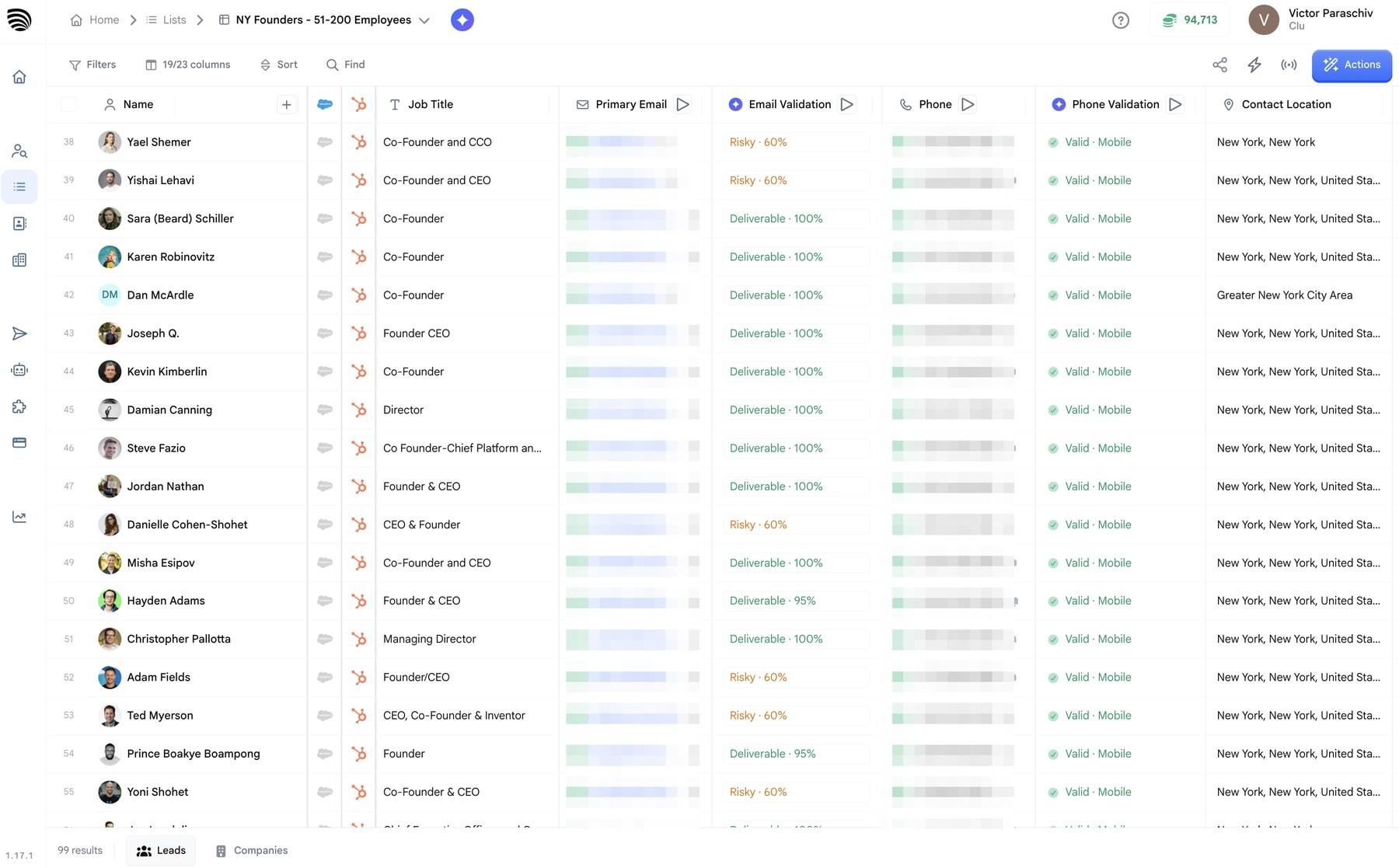 Clu's Phone Validation column flags line type per contact, here marked Valid Mobile, beside email deliverability
Weaknesses: It isn't a live check. It doesn't run an HLR lookup to confirm a line is in service, and it doesn't scrub against Do Not Call registries. If you need either, use a dedicated carrier API or DNC service.
Best for: SDR teams that need bulk validation as part of a broader enrichment workflow. Small teams who want a free plan plus a clear upgrade path.
2. Twilio Lookup (developer API)
Pricing: $0.005-$0.04 per lookup depending on data packets requested (basic carrier vs full HLR + SIM swap detection).
Strengths: Industry-standard developer API. Well-documented. Used by most fintech and on-demand apps for account signup phone validation. Strong global coverage.
Weaknesses: Per-lookup pricing makes bulk validation expensive ($40 for 1,000 lookups with line type + carrier). No bulk UI, you build the workflow yourself. Pricing creep when you enable multiple data packets.
Best for: Developers integrating phone validation into product signup forms or fraud-prevention workflows. Not the right tool for SDR list cleaning at scale.
3. NumVerify (free API tier)
Pricing: 100 free validations/month; $14.99/mo for 5,000 (~$0.003/number).
Strengths: Cheapest dedicated phone validation API on the market. Simple REST endpoint. Generous free tier for casual use.
Weaknesses: No HLR. No DNC integration. Documentation is sparse compared to Twilio.
Best for: Hobbyist projects and form-validation use cases where budget is the dominant constraint.
4. IPQualityScore (fraud-focused)
Pricing: $0.005-$0.015 per lookup depending on data depth and fraud score requirement.
Strengths: Best-in-class fraud signal layered on top of standard validation. Strong VoIP detection. Real-time API with sub-second response.
Weaknesses: Pricing model is opaque (volume tiers require sales conversation for accurate quote). The fraud score is more useful for fintech than B2B SDR teams.
Best for: Fintech, marketplaces, and any team where phone number is a fraud-prevention signal as well as a contact channel.
5. Veriphone (free browser tool)
Pricing: Free for single lookups; paid API starts at $9/mo for 1,000 lookups.
Strengths: Clean UI. No signup for the free tool. Good for one-off checks.
Weaknesses: Free tier is single-number only (no bulk upload). Paid API is small-volume only, for serious SDR use, the price-per-lookup at scale doesn't compete with Twilio or Clu.
Best for: One-off validation when you don't want to sign up for anything.
6. RealPhoneValidation
Pricing: $0.008-$0.015/number bulk; $19/mo minimum.
Strengths: Real bulk UI (not just an API). DNC scrub available as an add-on.
Weaknesses: International coverage drops significantly outside North America. UI feels dated. Pricing requires minimum monthly commitment.
Best for: US-focused outbound teams that want a bulk UI without writing API integration code.
7. Searchbug Phone Validator
Pricing: $0.05-$0.15 per lookup (skip-tracing pricing tier).
Strengths: Identity lookup is genuinely unique, useful for skip tracing, debt collection, and certain compliance workflows.
Weaknesses: Significantly more expensive than peer tools for basic validation. Identity data has privacy/compliance implications most B2B SDR teams don't need.
Best for: Skip-tracing, fraud investigation, debt collection. Overkill for typical sales list cleaning.
8. Telnyx Number Lookup
Pricing: $0.001-$0.005 per lookup (volume-tiered).
Strengths: Cheapest serious developer API for phone validation. Good documentation. Their carrier identity means data freshness is excellent.
Weaknesses: Developer-API only, no bulk UI. Account setup requires sales touch for higher volume.
Best for: Developers building phone validation into product flows at scale who want better pricing than Twilio.
9. AbstractAPI Phone Validation
Pricing: 250 free validations/month; $9-$249/mo for paid tiers.
Strengths: Generous free tier. Simple JSON API. Part of AbstractAPI's larger validation suite (email, IP, etc) which is useful for full-stack apps.
Weaknesses: Data depth doesn't match dedicated providers. No HLR. Best for casual use, not production SDR workflows.
Best for: Developers prototyping multi-validation flows (email + phone + IP) and budget-constrained projects.
10. ValidNumber.com
Pricing: Free single lookups; $20/mo for 5,000 bulk.
Strengths: Free single-number tool with no signup. Simple bulk UI.
Weaknesses: Limited depth compared to the dedicated carrier APIs above.
Best for: One-off casual checks. Not recommended for production sales workflows.
Side-by-side comparison
| Tool | Free tier | Paid bulk price | Best for |
|---|---|---|---|
| Clu | 14-day Pro trial, then 50 credits/mo | $49/seat/mo, 0.5 credits to validate, 10 per appended phone number | SDR teams + bulk lists |
| Twilio Lookup | 1,000 free trial | $0.005-$0.04/lookup | Developer integrations |
| NumVerify | 100/mo free | $0.003/number | Hobbyist projects |
| IPQualityScore | 200/mo free | $0.005-$0.015 | Fintech/marketplaces |
| Veriphone | Free single | $0.009/lookup | One-off checks |
| RealPhoneValidation | No free tier | $0.008-$0.015/number | US bulk UI |
| Searchbug | No free tier | $0.05-$0.15/lookup | Skip-tracing |
| Telnyx | Free tier limited | $0.001-$0.005/lookup | Dev APIs at scale |
| AbstractAPI | 250/mo free | $9-$249/mo | Multi-validation apps |
| ValidNumber.com | Free single | $20/mo for 5K | One-off casual |
How to choose the right phone validator
The decision tree most B2B teams should walk through:
- Do you need single-number lookups or bulk? Single = use a free browser tool. Bulk = use a paid waterfall or carrier API.
- Do you need format validation only, or carrier + HLR? Format-only catches malformed numbers. Carrier data adds line type. HLR is what confirms a line is in service.
- Is this for a product/signup flow or for a sales list? Product flows need a developer API (Twilio, Telnyx). Sales lists need a bulk UI or CSV upload (Clu, RealPhoneValidation), and the file-level mechanics are the same ones covered in how to enrich a CSV of leads.
- Do you need this in isolation, or as part of a broader workflow? Standalone validation = pick a dedicated tool. Part of an SDR/enrichment workflow = pick a platform that bundles phone validation with email verification, enrichment, and CRM sync.
For most B2B SDR teams dialing 5K-50K numbers per month, the cost-effective answer is a platform that bundles validation with enrichment, phone validation alone is rarely the whole job. Validation can only check a number you already have; it cannot supply one for the 30-50% of rows that carry no number at all, and appending those costs 10 credits a phone number in Clu, which is the arithmetic in our contact data enrichment breakdown. For developers building a signup form, the cost-effective answer is Twilio Lookup or Telnyx. And if the gap is mobile numbers on European prospects specifically, a LinkedIn capture tool is usually cheaper per dial than a full enrichment pass; the credit allocations and export ceilings are in our Kaspr pricing guide.
What happens when you skip phone validation
Three concrete consequences:
Wasted dial time. SDRs dialing an unvalidated B2B list waste 30-90 seconds per dead number. On a typical 60-dial-per-day cadence, that's 30-90 minutes per rep per day lost to dead numbers. Across a 5-person SDR team over a year, that's roughly $40K-$120K in fully-loaded labor cost.
Carrier-level spam flagging. Hiya's 2025 State of the Call report documented that 34% of B2B outbound calls are now flagged with "Spam Likely" or "Scam Likely" labels at the carrier level (T-Mobile Scam Shield, AT&T Call Protect, Verizon Call Filter). The primary trigger is dialing patterns, repeatedly hitting dead numbers is one of the strongest spam-flag signals. Validated lists reduce flag rates 40-60%, directly improving the percentage of calls that ring through.
TCPA / DNC exposure. Unvalidated lists often include numbers that have been reassigned from a business to a residential subscriber, or moved from landline to mobile (TCPA-restricted). The FCC's Reassigned Numbers Database is one source of truth; carrier-level HLR is another. Either way, calling a reassigned number without validation is a documented TCPA litigation risk.
Can you validate phone numbers via API?
Yes. Every serious phone validation provider exposes an API: you send a number, it returns the E.164 format, country, carrier, line type, and (on deeper tiers) a live HLR status. If you are wiring validation into a signup form or a fraud check, a dedicated lookup API is the right shape for the job.
For that developer use case, Twilio Lookup remains our pick, for the reasons covered above: excellent data quality, strong documentation, and per-lookup pricing from $0.005 to $0.04 depending on the data packets you enable. Telnyx is the value alternative at higher volumes.
If the numbers belong to a lead list rather than a signup flow, a standalone check is usually the wrong shape. Clu's API v2 finds phone numbers through a 25+ provider waterfall (85% of contacts on our 500-lead benchmark), and a signed cost quote is issued before any credits are spent, so a script or agent cannot overspend. The API is available on Pro and Enterprise plans. Phone validation itself runs as a column on a list inside the app.
How do I validate phone numbers in bulk?
Upload the list, pick the checks, run it, then export or sync the clean file. Bulk validation differs from a single lookup in three ways that decide the cost. It runs asynchronously, so a 50,000-row file comes back as a job rather than as a response. It is billed per row rather than per API call, which is why the per-lookup developer APIs get expensive at list scale. And it has to tell you what to do with each verdict rather than only what the verdict is, because a list is useful again only once the dead rows are separated from the live ones. Clu runs bulk validation as a column on the list, marking each number valid, invalid or unknown at 0.5 credits a number. A separate enrichment column fills the rows carrying no number at all, and the result can go into HubSpot or Salesforce, or out as a CSV.
Is this a cell phone number or a landline, and how do you check?
Line type is what tells you, and it comes from a carrier lookup rather than from the number's format. A US area code has not indicated mobile or landline since number portability arrived, so reading the prefix is guessing. A carrier lookup queries the published numbering databases for the operator currently assigned to the number and returns the line type with it: mobile, landline, VoIP or toll-free. That matters for two reasons past curiosity. Texting a landline fails silently, and in the US the TCPA treats a mobile number as a stricter consent case than a landline. An HLR lookup is the layer that confirms the line is actually in service. Clu returns line type and carrier, and doesn't run HLR.
Should you verify phone numbers before high-volume calling?
Yes, and the argument is carrier reputation rather than wasted minutes. Dialing dead numbers is one of the patterns carrier analytics engines score when they decide whether to stamp "Spam Likely" on your caller ID, and the share of B2B outbound calls already carrying one of those labels is in what happens when you skip phone validation above. Once a number is flagged, the cost lands on every later dial from it rather than on the one that triggered the flag. A high-volume cadence also compresses the timeline, because a 5,000-dial month reaches the bad rows fast enough for the pattern to register. Validate before the first dial, re-validate an active dialing list monthly, and rotate the numbers you dial from. Clu's validation column marks numbers valid, invalid or unknown at 0.5 credits a number, without a live network check. Validation is one step in keeping a calling list usable, and our guide to cold calling lists covers the others.
Does Google have a phone number validator?
Google has no consumer phone validation tool of its own. It publishes libphonenumber, the open-source library it built for Android, which parses a number, formats it to E.164, and reports whether it is possible and valid for a given country. Almost every validator on this page uses that library or an equivalent for the format layer, which is why the free tools agree with each other on formatting and disagree on everything else. libphonenumber cannot tell you whether a number is in service, who the carrier is, or whether the line was reassigned last quarter, because none of that is derivable from the digits themselves. That is the carrier and HLR layer, and it is a paid query in every product that offers it. Clu returns line type and carrier at 0.5 credits a number, and doesn't run a live in-service check.
FAQs
What's the most accurate phone validation tool in 2026?
It depends on what you need checked. For a live in-service signal, use a provider with HLR, such as Twilio Lookup. For line type and carrier on a sales list next to enrichment, use Clu. We haven't published a head-to-head accuracy test.
Is there a free phone validator I can use right now?
Yes, Veriphone and ValidNumber.com both run free single-number lookups with no signup. Clu's phone validator page now needs an account. A new Clu account opens on Pro for 14 days with 250 credits. Validation costs 0.5 credits a number, so that covers 500 numbers inside the trial (the free plan afterwards is 50 credits a month, or 100 numbers).
What's the difference between phone validation and phone verification?
Validation checks the number follows numbering rules (format, country code, length). Verification additionally confirms the number is currently in service via HLR or carrier check. Validation catches malformed numbers; verification can also catch dead lines.
How often should I re-validate my phone list?
Phone numbers decay at roughly 1.5-2% per month for B2B contacts. Re-validate active dialing lists monthly; re-validate the full CRM quarterly. Lists older than 12 months typically have 20%+ invalid numbers.
Will validating phone numbers improve my contact rates?
Significantly, for two reasons. (1) You stop wasting dials on dead numbers (25-40% of typical B2B lists). (2) Your caller ID stays cleaner because the spam-flag signal that comes from repeatedly hitting dead numbers goes away. Teams report 40-60% fewer spam flags and 2-3x higher connect rates per hour after validating.
Is phone validation legal?
Yes. Format and carrier validation reference published numbering plans and carrier databases, no call is placed, no personal data is queried. Numbers you call after validation must still comply with TCPA (US), CASL (Canada), GDPR (EU), and similar regional telecom regulations.

 Omni

 Decagon

 Distyl


 Sync to Salesforce
 Radar

 Distyl

 WellSaid
 Decagon
 Gamma
 Sanity
