






 Sanity
Choose a B2B data provider in four steps. Pick the operating model that fits the job: a contact database, a managed waterfall, a waterfall you build, an intent feed or a data API. Run your two or three finalists on the same 100 of your own records on the same day. Compare cost per accepted record, meaning what you paid divided by the rows that passed your own checks. Then ask the procurement questions before you sign.
The providers most teams end up testing, by model: Apollo.io and ZoomInfo for contact databases, Clu (our product) for a managed waterfall of 25+ providers run by AI agents, Clay for a waterfall you build yourself, 6sense and Bombora for intent data, and People Data Labs for data by API. All 12 are compared below the method, with prices checked October 1, 2026 unless a row names another date.
Step 1: Pick an operating model
B2B data providers sell the same nouns (work emails, direct dials, titles, firmographics) through five operating models. The model decides where the data comes from, how stale it can get and what happens to the people the vendor does not hold, so pick it before you pick a vendor.
| Operating model | How it works | Providers on this page | Pick it when |
|---|---|---|---|
| Contact database | You search and export from one company's stored index, refreshed on its schedule | Apollo.io, ZoomInfo, CUFinder, Cognism, UpLead, RocketReach | You want to browse and size a market, or search and send from one seat |
| Managed waterfall | Each record goes through many providers in sequence and is verified at request time | Clu | Coverage and bounce rate matter more than browsing an index |
| Waterfall you build | You choose the providers, their order and the logic for each row | Clay | You have a GTM engineer to build and maintain it |
| Company and intent data | Firmographics and account-level buying signals, rarely people | Clearbit (HubSpot Breeze), 6sense, Bombora | You rank accounts and already have contact data |
| Data API | Raw person and company records, billed by the record | People Data Labs | An engineering team is building data into a product |
Then ask where each field comes from. Providers blend five sources: crawling public sites and profiles, contributor networks where users share address books for credits, licensed feeds bought from other data companies, human research teams that call numbers to confirm them, and inference that builds an address from a company's email pattern. A guessed address passes a syntax check, so coverage can look close to 100% until the bounces land on your sending domain. Verification is a separate step: an SMTP check against the receiving mail server for email, and a line-type and ownership check for phone.
Step 2: Run the finalists on the same sample
Take 100 records from the segment you will actually buy, never a vendor's sample. Make about 60 of them records whose truth you can check (customers, people who replied to you, executives listed on their own company site) and 40 genuinely cold. If a third of your market sits outside North America, a third of the file should too. Strip every email and phone number you already hold, send first name, last name, company and domain, and run the identical file through each finalist within the same 24 hours, because coverage moves.
Grade every result with one verifier you control, never the vendor's own label. Record each email in one of three columns: verified, catch-all, or invalid and blank. A catch-all domain accepts every address, so no check can prove the mailbox exists; count it on its own and never as verified. Then send one plain message from a warmed secondary mailbox to 30 to 50 of each vendor's verified addresses and count hard bounces. For phones, dial 25 numbers per vendor and log connected, wrong person and switchboard. One hundred records separates two vendors that are far apart on your list. Treat a gap of a few points as a tie and break it on terms.
Step 3: Compare cost per accepted record
An accepted record is a row that passed your checks: a verified email, plus a phone that connected if you buy phones. Cost per accepted record is your total annual spend (plan price times 12, plus seat charges, plus overage) divided by the accepted records it buys. Credits granted and database size are not part of the formula.
Two billing rules move the result more than the sticker price. A vendor that bills a lookup that finds nothing raises your real rate by your miss rate: at a 30% miss rate, a nominal $20 per 1,000 emails is really $28.57 per 1,000 delivered, and at 50% it is $40.00. A vendor that bills a catch-all as a verified email moves it the same way. Ask for both rules in writing, per data type.
For scale, our pricing index read 37 vendor pricing pages on September 1, 2026. The 18 discovery vendors that publish enough to compute it charge from $13.00 to $435.29 per 1,000 verified emails on annual billing, a 33.5x spread for the same unit, with a median of $39.13. On published prices checked October 1, 2026, Clu (our product) is $89 per seat a month on Pro with 1,500 credits per seat: about 5.9 cents per verified work email at 1 credit and about 59 cents per phone number at 10 credits. Apollo Basic grants 30,000 credits a year per user for $588, about 2 cents an email credit, and a phone number costs 8 credits. UpLead Essentials works out to about 58 cents per contact on monthly billing. People Data Labs Self-Serve is 28 cents per person record at its entry allowance (September 1, 2026). At the top end, Vendr records a $33,500 median ZoomInfo contract across 1,574 purchases.
Step 4: Ask the procurement questions
- Do you charge for a miss or a catch-all? Get the answer per data type, because email and phone often differ.
- When was each field last verified, and from which source? A value with no date cannot be graded.
- What is the contract shape? Look for annual-only tiers and seat minimums. On the September 1, 2026 index, Apollo's Organization tier carried a 3-seat minimum and UpLead's Professional tier was annual only.
- Do unused credits roll over? Ask what happens to the balance on a downgrade and on cancellation. Apollo grants its annual credits upfront and its pricing page published no rollover terms on September 1, 2026.
- What does overage cost? Clay sold top-up credits at a 30% premium and UpLead charged $0.60 per extra credit on the same date.
- What is your lawful basis, and will you sign a DPA? Ask how opt-outs and deletion requests reach every copy, and whether phone numbers are screened against do-not-call registries.
- Is the CRM sync one-way or two-way? Ask whether it updates the existing record or creates a duplicate, and which fields it may overwrite.
- What happens at renewal? Price increases, the notice window and whether you can downgrade mid-term.
The 12 B2B data providers compared
Prices are read from each vendor's own pricing page on October 1, 2026 unless the row names another date or source.
| Provider | Type | Entry price | Free option | Best for |
|---|---|---|---|---|
| Apollo.io | Contact database plus sequencing | $49/user/mo, annual | 900 credits/yr | Startups that want data and sending in one seat |
| ZoomInfo | Contact, company and intent platform | No published price ($33,500/yr median, Vendr) | ZoomInfo Lite | Enterprise teams using data, intent and org charts together |
| Clu (our product) | Contact data from a 25+ provider waterfall, with AI agents and sequences | $49/seat/mo | 14-day Pro trial, then Free plan at 50 credits/mo | Outbound teams that want verified emails, direct dials and the send in one tool |
| CUFinder | Contact and company search plus enrichment | $49/mo for 1,000 credits (Oct 28) | 50 credits/mo, no card | Teams that want data and buying signals without seat fees |
| Cognism | Contact database, phone-verified | No published price | None | EMEA outbound under GDPR |
| UpLead | Contact database | $99/mo ($74/mo annual) | 5 credits, 7-day trial | Small teams on monthly billing |
| RocketReach | Contact lookup | $329/yr, email only (Sep 1) | 5 lookups | Occasional lookups and recruiting |
| Clay | Enrichment workflow builder | $185/mo ($167/mo annual) | 100 data credits/mo | GTM engineers building their own waterfall |
| Clearbit (HubSpot Breeze) | Company and contact enrichment in HubSpot | No standalone price | None standalone | HubSpot teams enriching CRM records |
| 6sense | Intent and ABM platform | No published price | None published | Enterprise account-based marketing |
| Bombora | Intent data | No published price | None published | Feeding intent topics into an existing stack |
| People Data Labs | Person and company data API | $98/mo for 350 records (Sep 1) | 100 records/mo, contact fields hidden | Engineering teams building data into a product |
Five of the twelve publish no price, so a sales call is the only way to learn what they cost. Per-user pricing (Apollo) grows with headcount even when usage is flat, while workspace pricing (Clay) and record pricing (People Data Labs) does not. Clu is priced per seat, and every seat's credits go into one shared balance.
Contact data providers for outbound
These providers sell named people with work emails and phone numbers. Most sell from a database of their own; Clu owns no database and finds each contact through 25+ providers. They are what most teams mean by "B2B data provider".
1. Apollo.io: best for startups that want data and sending together
Type: contact database with built-in sequencing and a dialer on higher plans. Price: free plan with 900 credits a year. Basic $49, Professional $79 and Organization $119 per user a month on annual billing, Organization with a three-user minimum (apollo.io, October 1, 2026). Monthly billing is offered on Basic and Professional.
Apollo.io is the default first purchase for startups because one seat covers search, enrichment and email sequences, and the free plan is usable. The trade-off is per-user pricing and single-database coverage. In Clu's 1,000-lead March 2026 test of two tools, Apollo matched 78% of emails against ZoomInfo's 84%. The head-to-head is in Apollo vs ZoomInfo.
2. ZoomInfo: best for enterprise teams that use the whole platform
Type: contact and company database with intent signals, org charts, a dialer and conversation intelligence. Price: no published price. ZoomInfo's pricing page returned HTTP 403 on October 1, 2026. Vendr reports a median of $33,500 a year across 1,574 recorded purchases, ranging from $7,220 to $155,730 (Vendr ZoomInfo buyer guide, updated February 2026). Contracts are annual.
ZoomInfo is the broadest single platform in the category and the strongest fit for an enterprise team that will use contact data, intent and org charts together. It is hard to justify when the team mostly uses the search box. If you are pricing a renewal, the ZoomInfo competitors by segment page maps who competes with each part of the platform, and the ZoomInfo pricing guide covers the seat math.
3. Clu (our product): best for outbound teams that want verified contacts and the send in one tool
Disclosure. We make Clu. Its 98% verified email and 85% direct dial figures come from our own 500-lead benchmark, which named no other vendor.
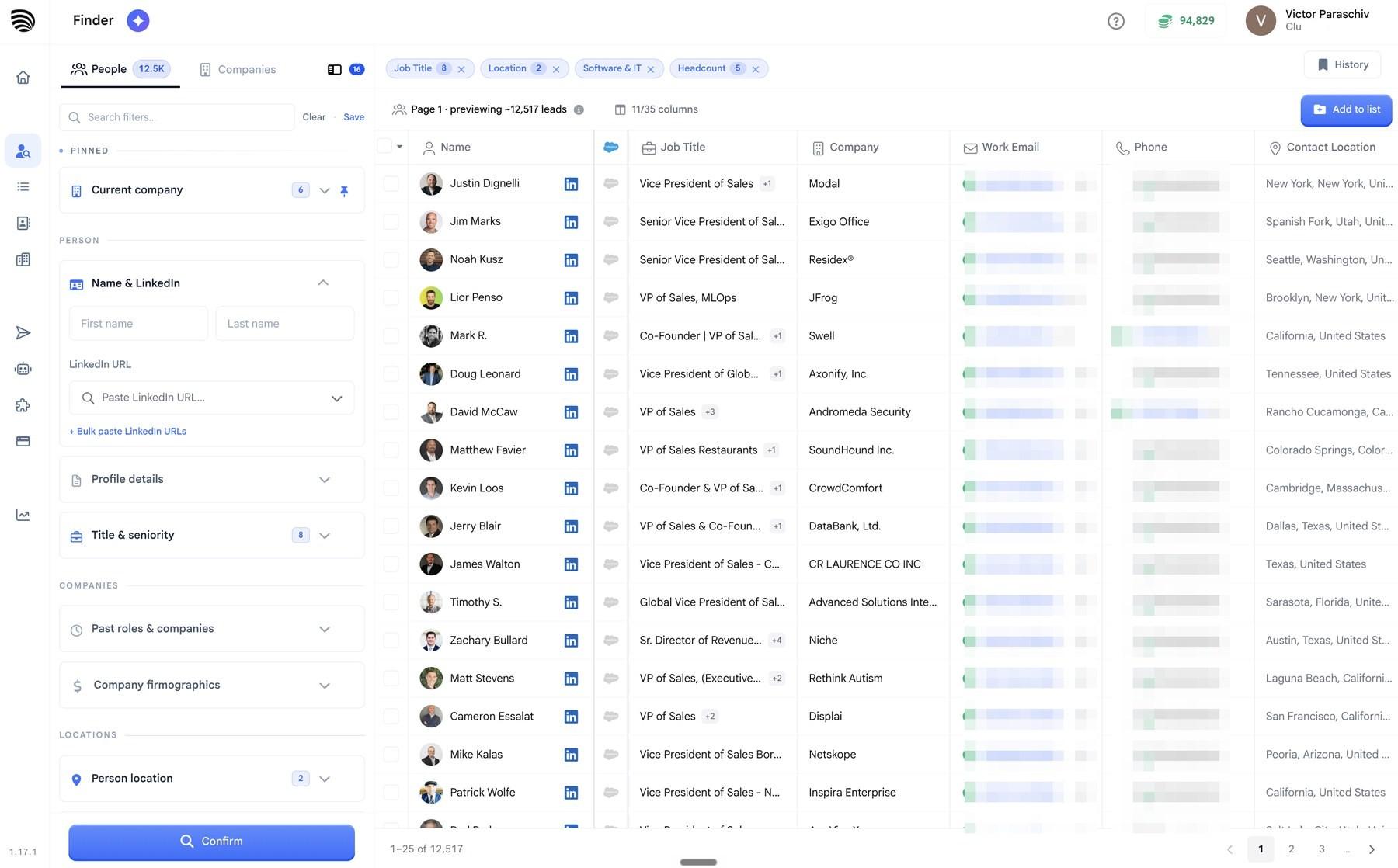
Clu gives you AI agents that run your GTM. Clu, our GTM agent, finds buyers across 1B+ profiles, gets verified emails and direct dials from 25+ providers, writes and sends sequences, and syncs to HubSpot or Salesforce. Starter is $49 a seat a month, and always-on agents and CRM sync start on Pro at $89.
Type: AI agents over a waterfall of 25+ data providers, with no database of its own. Price: Free plan with 50 credits a month. Starter $49 and Pro $89 per seat a month ($37 and $67 billed annually), Enterprise custom (clugtm.com/pricing).
Our product
Clu
Clu publishes this page. Accuracy figures are from our own benchmark, not a third-party test.
Clu: best for outbound teams that want verified work emails and direct dials from one waterfall on a monthly plan. Clu runs waterfall enrichment across 25+ data providers in sequence and stops at the first deliverable result, at 1 credit per verified work email and 10 per phone number. A missed email or phone number costs nothing. It returns 98% verified work emails and 85% phone numbers on the Clu 500-Lead Enrichment Benchmark, which is our own test run on a 500-lead sample. Plans start at $49 per seat a month.
Clu, our GTM agent, turns one sentence into an agent that searches 1B+ profiles, enriches and verifies every person it finds, adds them to a sequence and posts each run to Slack, every week or on a CRM trigger.
- Product
- Plans
Free plan 50 credits a month. Starter $49 and Pro $89 per seat a month, and every seat adds its credits to one shared balance. Enterprise is custom. 25% off on annual billing.
- Credits
- Verified work email1
- Phone number10
- Both on one row11
- Validation0.5
- AI qualification5
- Trial
14 days of Pro, free: 250 credits, 3 seats, agents, Sequences and Clu in Slack.
- Fits when
- You need a work email and a phone number on the same row, verified, not two exports you reconcile by hand
- You want the finished list written straight into HubSpot, Salesforce or pushed to Salesloft, Lemlist rather than downloaded as a CSV you re-upload
- Pairs with
- Your existing sequencer, if you already run one. Clu pushes to Salesloft and Lemlist, and its own Sequences run email and call steps
- Your intent or signal vendor, if buying-stage scoring is part of your motion
Clu fits when the bottleneck is data quality: one clean list a week with email and phone number on the same row, sent through its own Sequences from Starter or written into HubSpot or Salesforce on Pro. It sells no intent data or technographic filters and has no built-in dialer (Sequences set call tasks). See how the waterfall enrichment runs.
4. CUFinder: best for data and buying signals without seat fees
Type: contact and company search with a 15+ service enrichment engine, buying signals and an API. Price: Lite $49 a month for 1,000 credits, up to Premium at $449 for 20,000, about 30% less on annual billing. One successful match costs one credit, "Not Found" rows are free, every plan includes unlimited teammates, and the free plan gives 50 credits a month with no card (cufinder.io/pricing, October 28, 2026).
CUFinder is built for teams that are tired of paying per seat for data. By CUFinder's own description, you search 1B+ contacts and 85M+ companies with firmographic and role filters, then enrich any list with 15+ services in one upload: emails, direct dials, LinkedIn URLs, revenue, tech stack, funding and more. A separate local business database covers 200M+ small businesses worldwide, down to the owner, 99 types of buying signals tell you when to reach out, and 50+ API endpoints plug the same data into your own stack.
5. Cognism: best for EMEA outbound under GDPR
Type: contact database built around phone-verified mobile numbers (Diamond Data). Price: no published price. Standard and Pro each include 5 seats, and there is no free tier (cognism.com, October 1, 2026).
Cognism is the usual pick for teams selling into the UK and Europe, where its human-verified mobiles, GDPR-focused sourcing and do-not-call screening matter more than raw database size. It also offers Bombora intent data. North American teams have more self-serve options at published prices. See Cognism alternatives if you are weighing it against US-first tools.
6. UpLead: best for small teams on monthly billing
Type: contact database with real-time email verification at export. Price: 7-day trial with 5 credits. Essentials $99 a month for 170 credits ($74 a month on annual billing), Plus $199 for 400 credits ($149 annual), Professional custom and annual only (uplead.com, October 1, 2026).
UpLead is a self-serve database where one credit returns both email and mobile for a contact, and UpLead publishes its own 95% data accuracy guarantee. The low monthly credit count makes it a fit for targeted lists more than bulk enrichment.
7. RocketReach: best for occasional lookups and recruiting
Type: contact lookup tool over a large profile index. Price: Essentials (email only) $329 a year, about $27 a month, with 1,200 exports a year. A free account gets 5 lookups, and team plans start at $6,000 a year (rocketreach.co, September 1, 2026; the page did not serve prices on October 1).
RocketReach suits a recruiter or seller who needs one contact at a time. Essentials covers email only, and the annual export cap limits bulk work.
Multi-provider (waterfall) enrichment
These tools query several providers per record and keep the first verified result. Coverage depends on how many providers sit in the chain and who maintains it. Clu, third above, runs a waterfall of 25+ providers for you; Clay lets you build your own.
8. Clay: best for GTM engineers building their own waterfall
Type: spreadsheet-style workflow builder that calls many data providers and AI research steps per row. Price: free plan with 500 actions and 100 data credits a month. Launch $185 a month ($167 on annual billing), Growth $495 ($446 annual), Enterprise custom. Unlimited seats on every plan (clay.com, read September 7 and October 1, 2026).
Clay gives a technical team full control over which providers run, in what order, and what happens to each row afterwards. That control costs setup time and a person to maintain the workflows, and Clay meters actions and data credits separately. For how managed and DIY waterfalls compare, see the best waterfall enrichment tools.
Also worth a look: Zeliq
Zeliq pairs a 450M+ contact database with a waterfall that pulls verified emails and direct dials from 40+ providers, plus email, LinkedIn and call sequences. The Basic plan is free, Starter is $59 a user a month with 750 credits, and the 14-day trial needs no credit card (zeliq.com/pricing, read October 29, 2026).
Firmographic and company data providers
Firmographic providers describe companies: industry, headcount, revenue band, location, funding and corporate structure. ZoomInfo sells this alongside its contacts. Dun & Bradstreet (Hoovers) is the long-standing source for company records and corporate family trees, and Crunchbase covers startups, funding rounds and acquisitions. We did not verify a price for either for this update.
9. Clearbit (HubSpot Breeze Intelligence): best for HubSpot teams
Type: company and contact enrichment inside HubSpot. Price: no standalone price. Clearbit is part of HubSpot, and the capability ships as Breeze Intelligence credits inside a HubSpot account. HubSpot publishes a credit overage rate of $0.010 per credit, and no pack price (clearbit.com and HubSpot billing documentation, September 1, 2026).
Breeze Intelligence is the low-effort option for a team already on HubSpot: firmographic fields fill in on CRM records and forms without a separate tool. Teams on another CRM get little from it. The Clearbit alternatives page covers the options outside HubSpot.
Intent data providers
Intent providers tell you which accounts are researching a topic now. They name companies, rarely people, so they pair with a contact data provider.
10. 6sense: best for enterprise account-based marketing
Type: intent and ABM platform with predictive account scoring. Price: no published price. The pricing page lists three Sales Intelligence editions and asks for a demo (6sense.com, October 1, 2026).
6sense identifies accounts in a buying cycle, scores their stage and orchestrates campaigns against them. It fits enterprise marketing and sales teams with RevOps capacity to implement it.
11. Bombora: best for feeding intent topics into an existing stack
Type: topic-level intent data from a data co-op of B2B publishers. Price: no published price (bombora.com/pricing, October 1, 2026).
Bombora's Company Surge data flags accounts reading more than usual about a topic. Several platforms, Cognism among them, license it, so many teams buy Bombora intent through a tool they already own.
Data-as-a-service APIs
API providers return raw person and company records for engineering teams to build into products, scoring models or internal tools.
12. People Data Labs: best for engineering teams building on data
Type: person and company data API with bulk licensing. Price: free Testing tier up to 100 records a month with emails, phones and addresses hidden. Self-Serve $98 a month from 350 person records, or $940 a year. Bulk Data custom and annual only (peopledatalabs.com, September 1, 2026).
People Data Labs bills by the record with no seats, which suits a data pipeline with no user to count. The per-record price falls with volume. Details are in the People Data Labs pricing guide, and API options across vendors are in the best B2B data enrichment APIs.
Providers inside the Clu waterfall. Lusha (contact data with a Chrome extension), Hunter (email finding and verification) and Crustdata (company and people data API) are B2B data providers in their own right, and each supplies data to the Clu waterfall. They are credited here and left out of the numbered list, and Clu is not scored against them.
Which B2B data provider fits your team?
- Solo founder or seed-stage startup: Apollo.io. The free plan and the $49 Basic seat cover data and sequencing.
- Lean GTM team that wants buyers found, verified and contacted in one platform: Clu (our product). Clu finds the buyers, gets verified emails and direct dials from 25+ providers and sends the sequences, or hands the list to Salesloft or Lemlist.
- Selling into the UK and Europe: Cognism, for phone-verified mobiles and GDPR-focused sourcing.
- Enterprise team that will use data, intent and org charts together: ZoomInfo.
- RevOps on HubSpot that wants company fields filled automatically: Clearbit (Breeze Intelligence).
- GTM engineers who want to own the provider chain: Clay.
- Product or data team building on an API: People Data Labs.
- Enterprise ABM: 6sense. If you only need intent topics in your current tools, Bombora.
- Small team that wants a classic database on monthly billing: UpLead.
- Recruiters and occasional lookups: RocketReach.
If what you need is a searchable list of people, the B2B contact database comparison goes deeper on that one category. For the tools that turn data into outreach, see the sales prospecting tools and AI lead generation tools comparisons.
Frequently asked questions
Which B2B data provider has the most accurate data?
No independent test covers every provider, so treat each vendor's accuracy figure as its own claim. In Clu's 1,000-lead March 2026 test of two tools, ZoomInfo matched 84% of emails and Apollo 78%. Clu returned 98% verified work email and 85% phone numbers on the Clu 500-Lead Enrichment Benchmark, our own test on a 500-lead sample. UpLead publishes a 95% accuracy guarantee. The test in step 2 is the one that settles it for your list.
Are B2B data providers GDPR compliant?
Compliance depends on how each provider sources data and what contract it signs with you. Cognism builds its product around GDPR-focused sourcing and do-not-call screening. Most providers, Clu included, publish a data processing agreement; Clu's is at /dpa. In the EU and UK, B2B outreach usually rests on legitimate interest, which you document in a balancing test of your own.
Should I use more than one B2B data provider?
Yes, if a single source matches less than about 70% of your list, which is common outside North American software. Each provider has gaps by region, seniority and industry, and a second source fills some of them. You can stitch providers yourself, build the chain in Clay, or use a managed waterfall like Clu, which runs 25+ providers in sequence and stops at the first verified result.
Can I get B2B data for free?
In small amounts. Apollo.io gives 900 credits a year, Clay 100 data credits a month, and People Data Labs 100 records a month with contact fields hidden. Clu opens every new workspace on a 14-day Pro trial with 250 credits and 3 seats, then keeps a Free plan at 50 credits a month. Free tiers are enough to run the 100-record test before you buy.
How long should a data provider pilot run?
Long enough to see one full cycle: about 30 days on a paid monthly plan covers one enrichment run, one support request and one invoice. Trial volumes are usually too small to measure a match rate you can defend, so use a trial for the mechanics and pay for one month to test production. Re-run the same test at every renewal, because contact data goes stale as people change jobs.
Can I negotiate a B2B data contract?
Yes, and terms move more than the price per credit. Credit rollover, seat count, the miss policy, a mid-term downgrade path and payment terms are the usual levers. Vendors with a published self-serve price rarely discount it, but they often extend credit expiry or add seats. Write any concession into the order form.
Is a B2B data provider the same as a B2B database?
Not always. A B2B database is one operating model: a stored index you search and export from. A B2B data provider is anyone who sells the data, which also covers waterfalls that hold no index, intent vendors that sell account signals and APIs that return raw records. The B2B contact database comparison covers the database model on its own.
How should you weigh mobile coverage against price?
By how much of your pipeline starts with a phone call. If reps dial more than they email, strong direct-dial coverage is worth a higher price, because a missing number costs a conversation. Compare cost per connected number: a cheap phone credit that returns a switchboard ends up the expensive one. Clu charges 10 credits per phone number and nothing for a miss, Apollo charges 8 credits per phone number, and UpLead bundles email and mobile into one credit.
References & Sources
- [1]
- [2]
- [3]
- [4]
- [5]
- [6]
- [7]
- [8]
- [9]
- [10]

 Omni

 Decagon

 Distyl


 Omni

 WellSaid
